I’m good at finding rabbit-holes. A few weeks ago my youngest asked me for help making a D&D character for his school game. This is literally the best thing that can happen as a parent: a child not only asking for help, but asking about something you can do, and something that will help them look good in front of their friends.
It’s been a while, but I still have my D&D Beyond subscription, and it must have got better in the three years I’ve been away from it.
Nope. How lazy do you have to be to make a billion in revenue with a 40% profit margin and still not be able to make a good character sheet generator for your flagship (well, M:TG aside) game?
To be fair, they’ve improved the very first steps of quickly making a character online — that’s super important for new players — and they’ve done a reasonable job. And they generally get all the tricky calculations to match the rules. It would be nice to see how things are calculated, and nit-pickers will still find some errors, but that’s the nature of the informal ruleset. It’s pretty good for online characters. But they haven’t fundamentally made it better in many years.
And… the PDF export is awful. You can see the heritage of pre-printed character sheets and the need to fit everything into two pages at the back of a printed book. It’s hidden behind a couple of menu clicks, as if they’re not too proud of it. There’s no need for every character and class to have exactly the same layout. We can do much better than a digital form. We just have to care enough about it.
Let me go through the principles we might want to follow to make a better character sheet.
- Things used together sit together, and things used at different times are kept apart. We should organise by game moment, not by rules category: group by what’s happening at the table — my turn, exploring, resting, looking something up.
- What can I do right now? Where we can, lay things out in turn order — action, bonus action, reaction. For example, bonus-action spells sit alongside other bonus actions instead of in a separate spell list.
- Show me the numbers. We can do better than spell text that says things like “your Wisdom modifier” without telling you what it is where you read it. We should print the final number you need at the place where you choose, and save you jumping around looking for a particular score.
- Collect all the boxes. Spell slots, ki and other consumable resources sit in one place as tick boxes you pencil in and erase. You can see what you’ve got left and what else you can use in one place — and it’s easy to reset at a long rest.
- Just the character. Cut the options you don’t need, push the ones you do. It’s better if a cleric’s sheet looks different to a barbarian’s. And we can do the hard work to make that happen.
- Scannable choices. Where the player is choosing between options — actions, spells, attacks, skills — we should use tables and lists. When they’re digging down, text is better. Don’t mix them; keep them separate.
- Tested at the table. The measure of the sheet is how quickly you can answer a DM’s question: how many page touches and seconds it takes to narrow down to the mode you’re in.
There are trade-offs in every approach. Let’s be honest about them.
- It’s harder to level up at the table. The right approach is to level up online and print a new sheet. This might not suit everyone.
- It’s harder to intuit the rules system behind the numbers. “DC 12 CON” instead of “8 + proficiency + WIS” means players never see where the numbers come from.
- It’s probably more paper. I always print out a spell book, so I don’t think that’s such an issue, but it may be important for you.
- It’s built for one way of playing: a physical table, a pencil and an available printer. That’s fine — if you play online, use the website.
I’ve been working on a system, Chaney*, to make better PDF character sheets for D&D Beyond characters. Without further ado, here’s a side-by-side comparison for Ponk Dingleberry, my youngest’s level 3 cleric. (I tried to get him to change the name!) Like the optician says: better or worse?
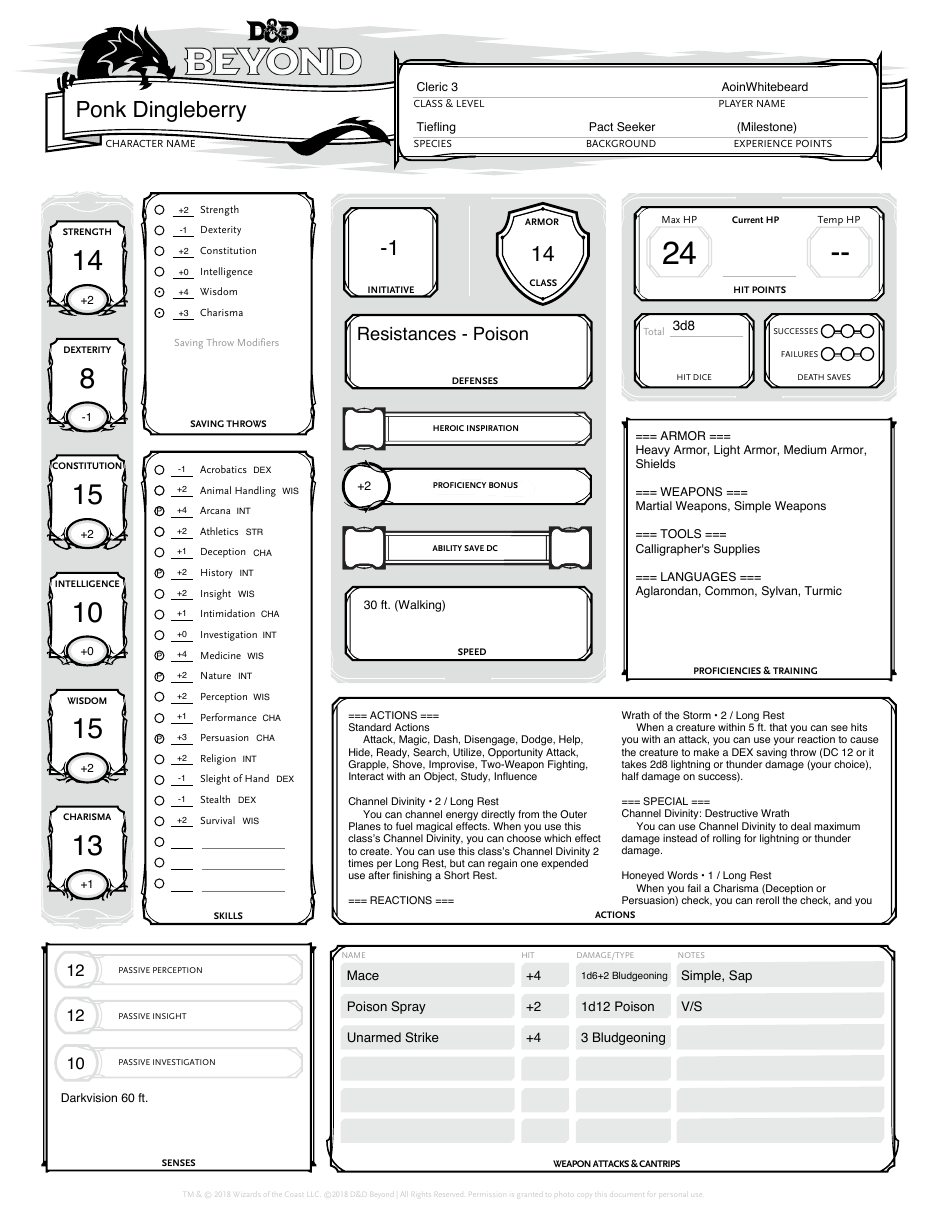
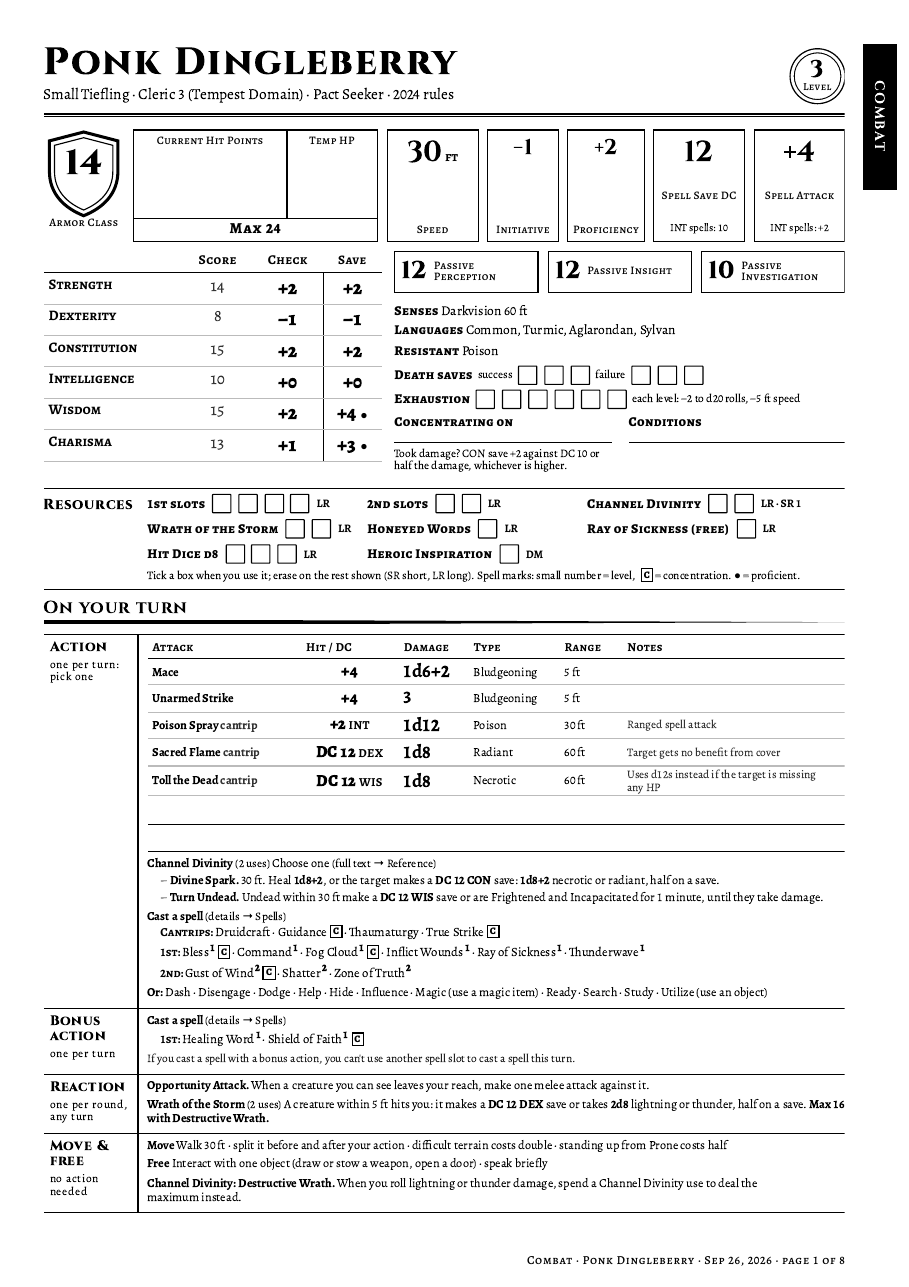
Page one of each: D&D Beyond on the left/above, Chaney on the right/below. Click either for the full PDF (D&D Beyond , five pages; Chaney , eight).
It’s early days. D&D Beyond doesn’t provide an official API, but you can get a JSON representation of a public character. Chaney is currently a bunch of scripts and Elm code that I’m not sure how to turn into a usable service. I’m working on it.
I could do with some feedback. Are the principles I’ve enumerated correct? Have I missed important trade-offs? Does no-one use paper character sheets any more? What even is a pencil? Shout, too, if you’d be interested in helping.
Feedback to me on Mastodon .
* After Lon Chaney , the man of a thousand faces — not Dick Cheney , who shot his friend in the face.